Detail Analysis
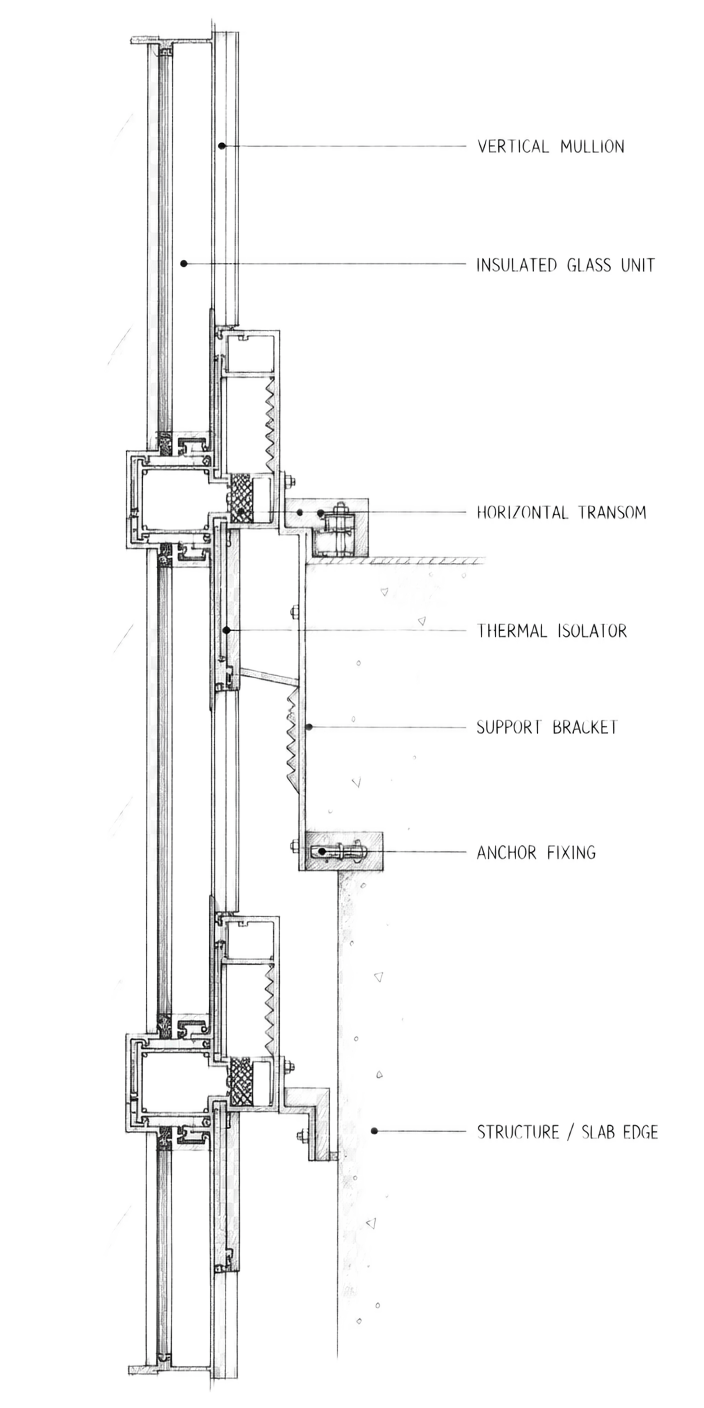
Read a façade detail and explain the construction logic: layer sequence, load path, sealing line, thermal separation and interfaces.
Output
Structured breakdown of the detail with evidence classification and open points
Private test version — Facadty is in active development and is not yet an end product. AI output must be reviewed by a qualified engineer.
Façade Engineering AI
A specialised AI engineering assistant for façade engineers, façade designers and technical teams. Facadty reads façade details, identifies components and systems, answers technical questions and drafts engineering descriptions — inside a controlled professional workspace.
Agent session — Detail Analysis
Live preview
Project context
Kai Tower — Unitised curtain wall, D-204
Reading evidence…
Simulated session. Every Facadty output is a draft for engineer review.
The problem
Façade engineering runs on details. The information needed to understand one junction is spread over section drawings, supplier data, specifications, calculations and the memory of the engineers who worked on the last comparable project.
Generic AI tools do not understand this context. They answer confidently without knowing what a stack joint, a serrated bracket or a drained and back-ventilated cavity actually implies, and they cannot tell what is drawn from what is assumed.
Facadty is built for this domain: it works from the evidence in the project, states what it cannot determine, and keeps every output traceable back to a detail, a document or a previous project case.
What the AI Agent can do
Read a façade detail and explain the construction logic: layer sequence, load path, sealing line, thermal separation and interfaces.
Output
Structured breakdown of the detail with evidence classification and open points
Identify mullions, transoms, brackets, fixings, profiles, panels, glass, insulation, anchors, gaskets, flashings and substructures.
Output
Component list with function, position and confidence level per item
Generate a professional engineering description of a façade system or detail, written for specifications and technical reports.
Output
Draft description text in engineering language, ready for engineer review
Ask a targeted façade engineering question in the context of a project, its documents and previous analyses.
Output
Reasoned answer with cited evidence and explicit statement of what is unknown
Assemble analyses, descriptions and component data into consistent documentation for a project package.
Output
Structured documentation draft with traceability back to evidence
Example façade engineering tasks
Primary structure
Mullion
Vertical primary member transferring wind load to slab brackets
Transom
Horizontal member spanning between mullions, supporting infill
Substructure
Secondary framing carrying cladding back to the primary structure
Fixing and support
Bracket
Connects façade framing to slab edge; carries dead and wind load
Anchor
Transfers bracket load into concrete or steel substrate
Fixing
Bolts, screws and pins securing components within the assembly
Infill and envelope
Glass unit
Insulating glazing providing transparency, thermal and acoustic performance
Panel
Opaque infill: metal, stone, terracotta or composite cladding
Insulation
Thermal layer within spandrel, cavity or back pan
Sealing and weathering
Gasket
Compression seal at glazing rebate and stack joints
Flashing
Sheet metal directing water out of the assembly
Profile
Pressure plates, caps and adaptors completing the section
Evidence-based approach
Confirmed
Stated in an uploaded drawing, specification or project document.
Visible
Directly readable from the supplied detail or image.
Inferred
Engineering interpretation — must be verified by the engineer.
Unknown
Not determinable from the available evidence.
Facadty avoids unsupported assumptions and explicitly communicates uncertainty when information is missing, so the engineer always knows which parts of an answer still need verification.
The long-term vision
Facadty connects visual understanding, façade engineering knowledge, project context, AI reasoning and technical documentation into one controlled professional workspace.
Restricted platform
Only predefined and authorized users can reach the AI Agent. If your account has been provisioned, log in.
Log in